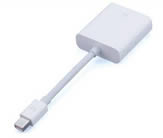
It appears that I have suffered the curse of Nvidia again, this time on my brand new work unibody Macbook Pro 13in. Under Windows Vista and 7 the Nvidia Geforce 9400M graphics card can only send a 640×480 resolution signal to projectors through the official Apple Mini DisplayPort to VGA adaptor.
It appears that I am not the only one, there is a large thread that is continuing on the Apple Discussions forum. There are a bunch of other people reporting the same issue, but Nvidia doesn’t have a solution yet. In fact, they have flat out said there are a huge list of unsupported (and will NEVER be supported) features. The following are from page 16 of the 190.62 Nvidia drivers release notes:
The following are features and functionality that were available in driver releases
supporting Windows XP, but are not–and will not be–available in driver releases for
Windows 7:
• High resolution scaling desktop (HRSD)
• MultiView Display Mode (for NVIDIA Quadro NVS graphics cards)
• NVKeystone
• Unified back buffer (UBB) controls
• OpenGL Video Overlays – This is an operating system limitation.
• Overclocking – GPU overclocking is no longer supported in the default GPU driver control panel. This feature is available in the NVIDIA System Tools software, which you can download from NVIDIA.com.
• GPU Temperature Monitoring – Temperature monitoring is no longer supported in the default GPU driver control panel. This feature is available in the NVIDIA System Tools software, which you can download from NVIDIA.com.
• AGP Settings Adjustment
• Video Zoom
• Pan & Scan ‐ the process of panning across the desktop in order to display a desktop on a monitor with lower resolution
• Per‐display Desktop Color Setting Adjustments – For Clone mode, the desktop color setting adjustments through the NVIDIA Control Panel can only be made across all displays in a system, and not on a per display basis.
• Per‐display Video Color Setting Adjustments – For Dualview mode, the video color setting adjustments through the NVIDIA Control Panel can only be made across all displays in a system, and not on a per display basis.
• Edge Blending
• Run display optimization wizard
• Run multiple display wizard
• Run television setup wizard
• nView Horizontal and Vertical Span Modes – Due to architectural changes in the new Windows Vista Window Display Driver Model (WDDM), span mode cannot be supported in NVIDIA graphics drivers. NVIDIA recommends using the built‐in Windows Vista multi‐display modes.
• Display/Connection Wizard (such as was provided with Windows Media Center Edition)
• DVD/MPEG Extensions (such as was provided with Windows Media Center Edition)
• Audio Extensions (such as was provided with Windows Media Center Edition)
• NVIDIA nView Desktop Manager – The nView Desktop Manager will not be included in drivers for GeForce products.
Exchange 2007 uses SSL certificates extensively across the IMAP, POP, IMAP, UM and IIS services. I assumed that adding an SSL certificate to one of the Domain Controllers would propogate that certificate across all the controllers. I guess it makes sense that I was wrong, SSL certificates aren’t something you want spread or activated widely. If you do need to move or copy the certificate across servers though, it is a simple 3 step process in the Exchange shell:
1) Export the certificate from the original server:
Export-ExchangeCertificate -Thumbprint 5113ae0233a72fccb75b1d0198628675333d010e -BinaryEncoded:$true -Path c:\certificates\export.pfx -Password:(Get-Credential).password
http://technet.microsoft.com/en-us/library/aa996305.aspx
2) Import the certificate into the new server:
Import-ExchangeCertificate -Path c:\certificates\export.pfx -Password:(Get-Credential).password
http://technet.microsoft.com/en-us/library/bb124424.aspx
3) Enable the new certificate:
Enable-ExchangeCertificate -Thumbprint 5113ae0233a72fccb75b1d0198628675333d010e -Services “POP, IMAP”
http://technet.microsoft.com/en-us/library/aa997231.aspx
Done!
I found when using Kohana in FastCGI mode that I was getting error 500 messages without the usual stack trace or error message. This was only happening when I accessed the development server remotely, not when I ran it locally (i.e. http://localhost/). Turns out this is actually the default behaviour for IIS7 with FastCGI. To change this you simply run the following command:
%windir%\system32\inetsrv\appcmd.exe set config -section:system.webServer/httpErrors -errorMode:Detailed
All fixed! If you want to change it back when you put the server into production then change the errorMode to “DetailedLocalOnly”.
Sometimes people ask me, why do I like Microsoft so much? Most people think it is because of Steve Ballmer, but that is only part of the reason. Really I have loved Microsoft since early in my university days. I even have some content dedicated to myself on the Microsoft.com domain! Wow what a fanboi.
In fact I don’t love Microsoft, I just respect them. Look at the number of markets they are in. Look at how fiercely they fight in those markets. You fear Google will outsmart you if they enter your market, but you fear Microsoft will destroy you by any means necessary. Are they overly ruthless? Even unethical?
Personally I don’t think so, I think they are not afraid of competing and competing hard. Their haters might say their staff are “injected with blue blood”, but wouldn’t you like your company culture to be that strong? Wouldn’t you like to get market dominance, even if it means trench fighting your competitors? What’s so wrong with wanting to be the best? Surely this isn’t just my ego talking.
When starting the Cellular Emulator included in the Windows Mobile 6 SDK I received an error “Com17 is used please verify”. This is a particularly annoying error because it completely prevents the program from even starting. Where is the setting to manually select a COM port?
Anyway I managed to stumble upon a solution on the MSDN forums and I am reposting it here so other people find it a bit more easily:
The best part about this fix is that it is permanent. No need to disable the devices every time you start the Cellular Emulator, it remembers how to make everything work properly. Why couldn’t it do that in the first place?
Hand a few problems with this error on a new hosted domain controller that uses a VPN to connect back to the head office. Got some tips from Expert Exchange, but to summarise the various steps you should check are simple but effective (and as usual mostly DNS related):
I really wish the DNS lookup that Active Directory did was a little more resilient (i.e. if the first DNS server lookup fails then use the secondary).
Live Mesh is getting a getting the Service Update that was promised before the holiday release blackout period today. The key bug fix that everyone is hanging out for is that it will now not kick Windows 7 into it’s non-Aero interface. This will soon include me, because I have a freshly burned copy of Windows 7 sitting on my desk ready to be installed tonight. I guess I will be completing the Windows Connect install survey tomorrow, fingers crossed they give out valid licence keys at the end of the beta program like they did for Vista.
One interesting point I noted was that the Live Mesh Blog no longer appears to be labelled “Beta” or “Tech Preview”. The version update appears to only be a minor one (0.9.3424.5 to 0.9.3424.14), however it looks as though some subtle steps towards a debut are occurring. Perhaps one of these will be matching Skydrive’s 25 GB storage limit? I live in hope.
Amit Mital kicked off TechEd Australia 2008 today with a keynote presentation on Microsoft’s view of how software and services will develop in the future, particularly in relation to their new Live Mesh offering. There is a good summary of his presentation on the TechEd New Zealand site, it seems they got an identical opening keynote. For someone who loves networks he sure doesn’t seem to like professional networks!
There was one flow of logic which struck me in his speech. Moore’s law is still holding true, and computer hardware is continuing to double in processing power every 18 months. This computer power is also appearing in more and more locations. But when was the last time your network doubled in speed? What about doubling in speed to each additional node? This rapid processing power increase has meant two things that are obvious even today:
Microsoft’s solution at a high level is the Mesh stack, the structure of which can be seen in the slide shown here. The fundamentals are that local software is fast, hosted services are convenient, so lets tie them together with an API and we get the best of both worlds. The trick is getting the balance right, where does a local application end and the service begin? How do you split the business logic? How do you provide offline access and quick sign-on to new devices? Hmmm…
Microsoft’s current practical solution is to re-write most of its server packages to allow hosted delivery. Hosted Exchange is an obvious flagship for this. Google have taken a different approach. They believe that all you should need on your desktop is Chrome, essentially an all-purpose thin client rather than a thick client on a drip feed.
So who is right? Well I am betting things will converge on a middle of the road approach. Implmenting with current technology I would say that javascript, a web browser and some sort of XML interface would be the best way to go. A few things need to develop from here:
So I guess the race is on! Google will take Javascript to it’s limits, Microsoft will try to blow us away with it’s feature set. When will they sit down and standardise on the next generation of javascript and data format?
I was recently invited (for the third year in a row) to be filmed in a promotional testimonial for Microsoft TechEd Australia 2008. It was recently put online on the TechEd testimonials page, but I have uploaded a YouTube version to save everyone downloading Silverlight. Let me know what you think!
The video interview that I did for Microsoft TechEd 2008 is now online:
http://www.microsoft.com.au/teched/default.aspx
I am the third person speaking, in front of the orange “Explore” banner.